
Mastering advanced HVAC control can feel like solving a complex puzzle. One key piece? The expansion valve. This small but mighty component plays a huge role in managing refrigerant flow, ensuring your system runs smoothly and efficiently. Whether you’re a seasoned technician or just starting out, understanding how to optimize this part can make all the difference.
Think of the expansion valve as the gatekeeper of your HVAC system. It regulates the amount of refrigerant entering the evaporator, balancing temperature and pressure for peak performance. Incorrect sizing or installation can lead to high superheat levels or system swings, affecting overall efficiency1. That’s why getting it right is crucial.
From personal experience, I’ve seen how proper training and hands-on practice can transform your approach to HVAC challenges. Programs like those offered by RSI provide invaluable insights into components like the EEV (Electronic Expansion Valve), helping you troubleshoot and optimize with confidence. Ready to dive deeper? Let’s explore how this guide can simplify your journey toward better system control.
Key Takeaways
- An expansion valve is essential for regulating refrigerant flow in HVAC systems.
- Proper sizing and installation prevent performance issues like high superheat levels.
- Hands-on training programs, like RSI, offer practical insights into advanced HVAC control.
- Optimizing the valve improves energy efficiency and system longevity.
- Understanding core components like the EEV is key to mastering HVAC performance.
Welcome to Your HVAC Challenge and Expert Coffee Chat
Every HVAC system has its quirks, and mastering them is both an art and a science. Whether you’re dealing with fluctuating refrigerant flow or a misreading sensor, these challenges can feel overwhelming. But don’t worry—we’re here to help you tackle them head-on.
Your HVAC Challenges & How We Tackle Them
Improper refrigerant control is one of the most common issues in HVAC systems. It can lead to high superheat levels, frost formation, or even compressor short cycling. These problems not only affect performance but also increase energy costs2.
Another challenge is misreading sensors, which can cause incorrect temperature and pressure readings. This disrupts the balance of your system, leading to inefficiencies. Proactive maintenance and proper training can prevent these issues, ensuring your system runs smoothly2.
A Friendly Chat Over Coffee: Sharing Real-World Experiences
Imagine sitting down with a cup of coffee, discussing HVAC challenges with a seasoned technician. They share stories of troubleshooting a faulty valve or optimizing a refrigeration system for peak performance. These real-world experiences bring technical terms like controller and superheat to life.
For example, one technician recalls a case where improper refrigerant flow caused frost to form on the evaporator coil. By adjusting the EEV (Electronic Expansion Valve), they restored the system’s efficiency. These stories highlight the importance of hands-on training and practical knowledge.
| Common HVAC Challenges | Solutions |
|---|---|
| Improper refrigerant control | Adjust valve settings, monitor superheat levels |
| Sensor misreading | Calibrate sensors, ensure proper installation |
| Compressor short cycling | Check refrigerant levels, inspect electrical connections |
As you reflect on your current system’s performance, consider these data-backed solutions. With the right training and guidance, you can overcome any HVAC challenge. Ready to dive deeper? Let’s explore the core components of your system in the next section.
Understanding the Core Components of HVAC Refrigeration Systems
Understanding HVAC systems starts with knowing their core components. These parts work together to ensure efficient cooling and heating. Let’s dive into the essentials that keep your system running smoothly.
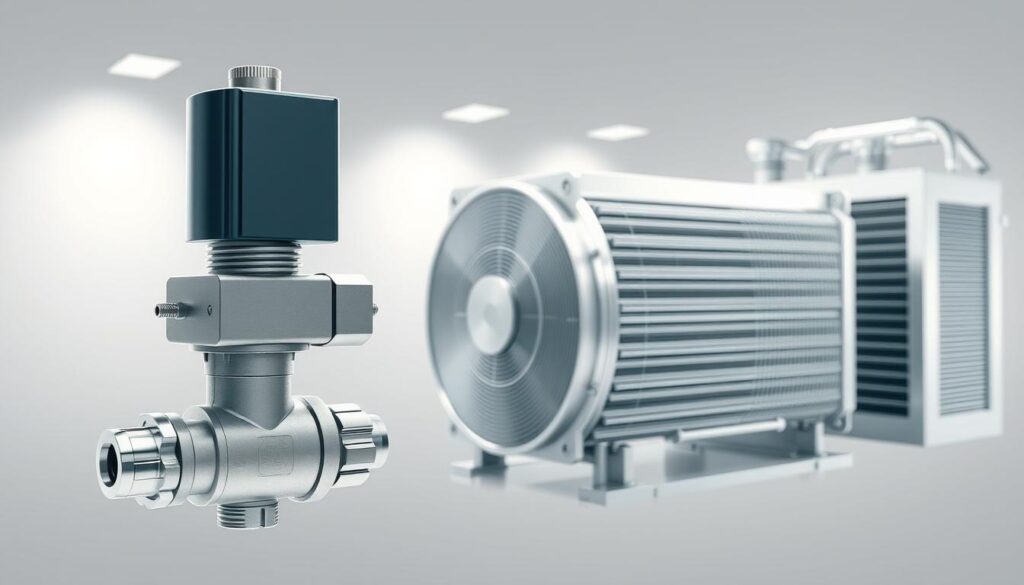
Compressor & Refrigerant Flow in Your System
The compressor is the heart of your HVAC system. It pressurizes and circulates the refrigerant, turning it from a low-pressure gas into a high-pressure heated gas3. Without it, no cooling would occur.
Think of the refrigerant flow like water moving through a garden hose. The compressor pumps the refrigerant through the system, ensuring it reaches the evaporator and condenser at the right pressure and temperature4.
Comparing TXV, EXV, and Capillary Valves
Valves play a critical role in controlling refrigerant flow. Here’s a quick comparison:
- Thermostatic Expansion Valve (TXV): Adjusts flow based on temperature and pressure changes. It’s reliable but less precise than electronic options3.
- Electronic Expansion Valve (EEV): Uses a controller to adjust flow with high precision. It’s ideal for systems requiring tight control4.
- Capillary Valve: A simple, fixed-size valve. It’s cost-effective but lacks adaptability for varying conditions3.
Proper valve selection ensures your system maintains optimal performance and avoids issues like high superheat or inefficient cooling4.
By understanding these components, you’re one step closer to optimizing your HVAC system. Next, we’ll explore how to fine-tune these parts for maximum efficiency.
Optimizing Your HVAC System with an Electronic Expansion Guide
Optimizing your HVAC system for peak performance starts with the right tools and techniques. One of the most effective ways to enhance efficiency is by implementing an electronic expansion guide. This approach not only improves system reliability but also ensures precise control over refrigerant flow.
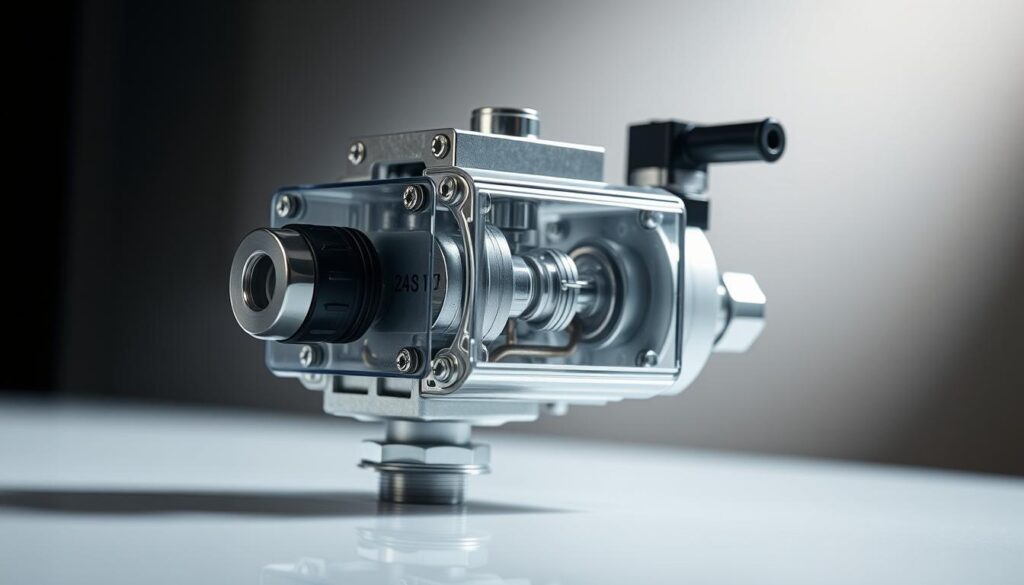
Key Benefits of Implementing This Electronic Expansion Guide
Using an EEV (Electronic Expansion Valve) offers several advantages. First, it allows for rapid adjustments, transitioning from fully closed to fully open in just a few seconds5. This quick response time ensures your system maintains optimal temperature and pressure levels. Second, it reduces freezing time by 10% compared to traditional valves, enhancing operational efficiency5.
Another benefit is energy savings. By preventing refrigerant flow during shutdown, the compressor experiences less load upon restart5. This not only lowers energy consumption but also extends the lifespan of your system.
Expert Tips and Data-Driven Insights for Maximum Efficiency
To get the most out of your EEV, consider these expert tips. First, ensure your sensors are calibrated correctly. Accurate readings from temperature and pressure sensors are crucial for precise control6. Second, use software to adjust superheat settings, which eliminates the need for physical adjustments5.
Here’s a quick comparison of valve types to help you make an informed decision:
| Valve Type | Key Features | Best Use Case |
|---|---|---|
| Thermostatic Expansion Valve (TXV) | Reliable, cost-effective | Residential systems |
| Electronic Expansion Valve (EEV) | High precision, rapid response | Commercial systems |
| Capillary Valve | Simple, fixed-size | Low-cost applications |
By following these tips and leveraging the right valve, you can achieve significant energy savings and improved performance. Ready to take the next step? The following section will guide you through adjusting your expansion valve for precise control.
Step-by-Step Guide to Adjusting Your Expansion Valve for Precise Control
Adjusting your expansion valve is like tuning a musical instrument—every small change makes a big difference. To achieve optimal performance, you’ll need to measure superheat accurately and make precise adjustments. This guide walks you through the process step by step.
Measuring Superheat Accurately for Reliable Performance
Start by attaching pressure gauges and temperature probes to your system. These tools help you monitor the refrigerant flow and ensure it’s within the ideal superheat range of 8–12°F7. High superheat levels indicate insufficient refrigerant entering the evaporator, while low levels suggest too much, which can damage the compressor7.
Allow your system to stabilize for 10–15 minutes after each measurement. This ensures accurate readings and prevents unnecessary adjustments7.
Small Increment Adjustments to Achieve Optimal Flow
Once you’ve measured the superheat, it’s time to adjust the expansion valve. Make changes in small increments—¼ or ½ turn at a time7. Think of it like fine-tuning a recipe; too much or too little can throw off the balance.
After each adjustment, recheck the superheat levels. This trial-and-error process ensures your system operates efficiently under both nominal and low-load conditions8.
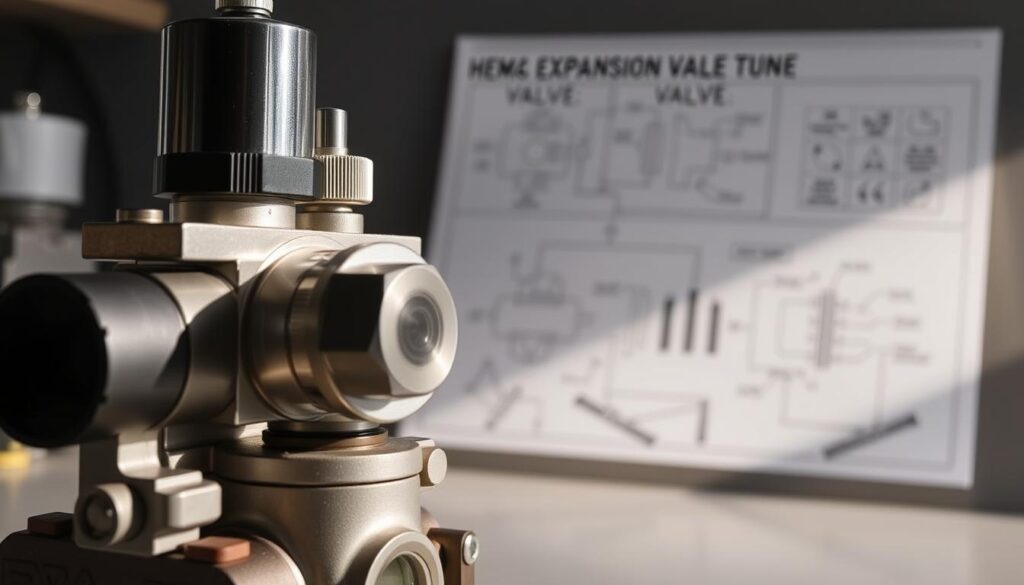
| Superheat Level | Action |
|---|---|
| Above 12°F | Increase refrigerant flow (turn counterclockwise) |
| Below 8°F | Decrease refrigerant flow (turn clockwise) |
Always follow manufacturer guidelines and prioritize safety. Proper calibration ensures your system runs smoothly, saving energy and extending its lifespan. Ready to take the next step? Let’s explore how integrating sensors and controllers can further enhance precision.
Integrating Sensors and Controllers for Enhanced Precision
Precision in HVAC systems relies heavily on the seamless integration of sensors and controllers. These components act as the system’s nervous system, constantly monitoring and adjusting to maintain optimal performance. When paired with an EEV (Electronic Expansion Valve), they ensure precise control over refrigerant flow, temperature, and pressure.

Leveraging Pressure and Temperature Sensors Effectively
Pressure and temperature sensors are the backbone of any HVAC system. They provide real-time data that controllers use to make adjustments. For example, a pressure sensor detects changes in refrigerant flow, while a temperature sensor monitors the evaporator coil’s heat levels. Together, they create a feedback loop that ensures the system operates within the ideal range.
Think of this integration as a finely tuned orchestra. Each sensor plays its part, sending signals to the controller, which acts as the conductor. This harmony allows for swift and accurate adjustments to the valve, preventing inefficiencies like high superheat or uneven cooling.
Here’s how these components work together:
- Thermistors: Measure temperature changes and send signals to the controller.
- Pressure Transducers: Detect pressure variations in the refrigeration system.
- Controller: Processes data and adjusts the EEV for optimal performance.
In one real-world example, a technician noticed inconsistent cooling in a commercial system. By calibrating the sensors and reprogramming the controller, they restored the system’s efficiency. This highlights the importance of proper sensor setup and maintenance.
By integrating these components effectively, you can dramatically reduce inefficiencies and ensure your system runs smoothly. Ready to take the next step? Let’s explore how industry data and hands-on training can further enhance your HVAC mastery.
Utilizing Industry Data and Hands-On Training for HVAC Mastery
Staying ahead in the HVAC industry requires more than just technical skills—it demands continuous learning and hands-on experience. With advancements in smart technologies and evolving system demands, professionals need to adapt by leveraging industry data and practical training. This combination ensures you’re not just keeping up but excelling in your field.

Learning Through Data-Driven Industry Insights and Trends
Industry data provides a roadmap for understanding emerging trends and challenges. For example, nearly 40% of HVACR jobs remain unfilled, highlighting the growing demand for skilled technicians9. This shortage is driven by advancements in technology, such as advanced controllers and remote diagnostics, which require updated skills9.
Programs like those offered by RSI provide over 2,600 instructional hours, ensuring you’re equipped with the latest knowledge10. Courses like Refrigeration I and II offer 18 hours of continuing education, recognized for NATE recertification10. These programs focus on practical skills, such as optimizing refrigerant flow and calibrating sensors, to improve system performance.
The Impact of Hands-On HVAC/R Training and Real-World Experiences
Hands-on training bridges the gap between theory and practice. For instance, RSI’s Copper Works course includes 3 CEUs, teaching you to handle refrigeration systems with precision10. Real-world scenarios, like troubleshooting a faulty valve or adjusting superheat levels, prepare you for on-the-job challenges.
One technician shared how hands-on training helped them optimize a system by adjusting the EEV, resulting in a 10% reduction in freezing time10. Such experiences highlight the importance of practical learning in mastering HVAC control.
Continuous learning through workshops and mentorship programs keeps you updated on industry advancements. With HVACR jobs projected to grow by 15% annually, staying skilled ensures you remain competitive9.
Conclusion
Taking your HVAC system to the next level starts with understanding its core mechanics. From optimizing refrigerant flow to integrating precise sensors, each step ensures better performance and energy efficiency. Real-world examples, like those from RSI graduates, show how mastering these techniques can lead to significant improvements11.
Whether you’re adjusting a valve or calibrating temperature settings, small changes can make a big impact. Advanced tools like EEVs (Electronic Expansion Valves) offer precise control, reducing maintenance costs and enhancing system reliability12. These innovations are transforming the industry, making it easier to achieve optimal results.
Ready to take action? Consider further training or consult with experts to refine your skills. Implementing these strategies not only improves your system but also ensures long-term savings and efficiency. Let’s continue the conversation—your next breakthrough is just a step away.
FAQ
What is the role of a compressor in my HVAC system?
How does a TXV differ from an EXV?
Why is measuring superheat important?
Can I adjust my expansion valve myself?
How do pressure and temperature sensors improve HVAC performance?
What are the benefits of hands-on HVAC training?
How can I optimize my HVAC system for maximum efficiency?
Source Links
- Microsoft Word – +030220811_EEV_OK_en.doc
- Trane Commercial Blog
- Understanding the Refrigerant Cycle – Trane®
- Refrigeration cycle, essential knowledge. – The Engineering Mindset
- EEV Valve Electronic Expansion Valve Advantages Work Priciple
- EEV Vs TXV In HVAC Systems: Precision Vs Simplicity
- The Expansion Valve Adjustment Guide | Refrigeration School, Inc. (RSI)
- Tech Tips for Thermostatic Expansion Valves
- HVACR ebook.indd
- Home
- Exploring The Role Of Expansion Valve In Chiller System 2025
- the role of the expansion valve



0 Comments